
A mid-sized manufacturing company supplying to global brands commits to Science-Based Targets (SBTi) to stay competitive. Within the first year, they announce emission reduction goals and publish an ESG report. However, during compliance review:
Their CPCB EPR registration is incomplete. Quarterly returns show inconsistencies. Waste recycling data does not match emission disclosures. Internal auditors identify a 20 to 30 percent gap in Scope 3 emissions reporting.
The company now faces delayed approvals, risk of penalties, and loss of credibility with investors.
This situation is increasingly common in India. Businesses adopt SBTi frameworks but fail to align them with regulatory compliance, which is where the real operational risk lies.
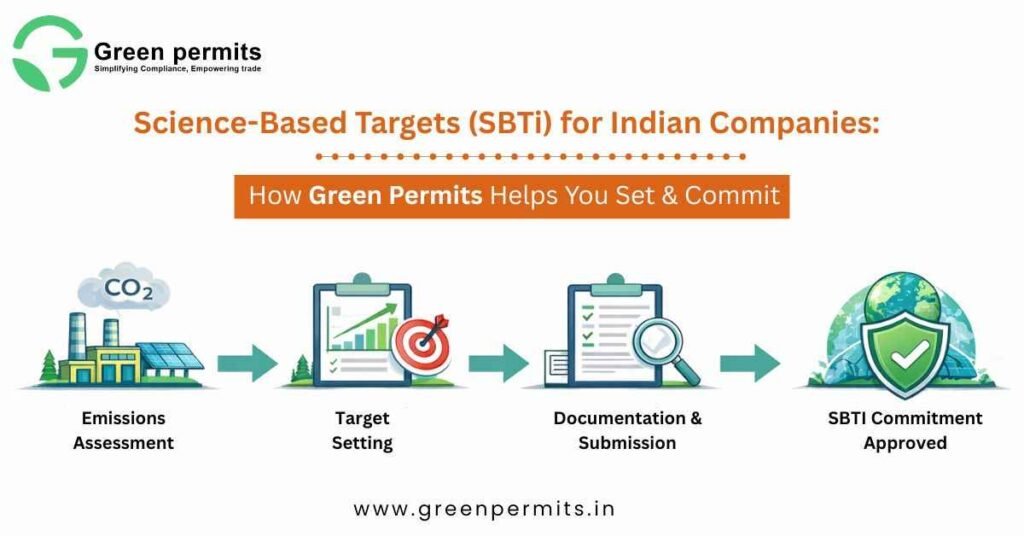
Science-Based Targets (SBTi) provide a structured way for companies to reduce emissions in line with global climate goals. However, in India, emissions are not just a reporting exercise. They are directly linked to regulatory compliance frameworks that govern waste, recycling, and environmental impact.
A typical Indian manufacturing or importing business operates in a system where sustainability is enforced through laws. Emissions are indirectly controlled through:
Waste management rules
Extended Producer Responsibility obligations
CPCB portal monitoring systems
Material recovery targets
In many sectors, especially electronics, automotive, and plastics, Scope 3 emissions contribute between 50 to 70 percent of total emissions. This means that waste generation, recycling efficiency, and lifecycle responsibility define a large portion of a company’s carbon footprint.
When companies ignore compliance while focusing on SBTi, the result is:
India’s regulatory ecosystem has evolved significantly between 2022 and 2025, making sustainability measurable and enforceable. The key shift is that environmental performance is now tracked through compliance systems rather than voluntary declarations.
The practical takeaway is clear:
SBTi is a global framework that helps companies set emission reduction targets aligned with climate science. It categorizes emissions into three major scopes, each representing a different source of impact.
Scope 1 covers direct emissions from company operations such as fuel usage, boilers, and industrial processes. Scope 2 includes indirect emissions from electricity consumption. Scope 3 is the most complex, covering emissions from supply chains, logistics, product use, and waste disposal.
For Indian businesses, Scope 3 is the most significant challenge because it extends beyond the factory. It includes everything from raw material sourcing to product end-of-life management.
In sectors such as electronics, automobiles, and consumer goods, Scope 3 emissions can account for up to 70 percent of total emissions. This is primarily because waste generation and recycling processes contribute heavily to environmental impact.
Companies often struggle with Scope 3 because it requires coordination across multiple stakeholders, including recyclers, logistics providers, and compliance authorities. It also requires accurate tracking of waste quantities and recovery rates.
Key implications for businesses include:
Ignoring Scope 3 leads to a situation where companies appear compliant globally but fail locally, creating both regulatory and reputational risks.
India does not mandate SBTi adoption, but it enforces environmental responsibility through a structured regulatory framework. These regulations collectively ensure that companies reduce environmental impact through measurable actions.
| Regulation | Requirement | Deadline | Applicable To | Risk |
|---|---|---|---|---|
| E-Waste Rules 2022 | EPR registration mandatory | Before operations | Electronics sector | Business restriction |
| Battery Waste Rules 2022 and 2025 | Recycling targets and reporting | Annual | Battery producers | Financial penalty |
| PWM Amendment 2025 | Barcode and traceability | From 2025 | Plastic sector | Public disclosure |
| ELV Rules 2025 | Recycling targets 8 to 18 percent | FY based | Automotive sector | Compliance penalty |
| EPA 1986 | Environmental protection | Continuous | All industries | Legal action |
These regulations function as the operational backbone of sustainability in India. Instead of focusing only on emissions, they regulate inputs and outputs such as waste, materials, and recycling efficiency.
For example, under EPR frameworks, companies are required to ensure that a defined percentage of their products are recycled. This directly reduces the need for virgin material extraction, which in turn lowers emissions.
In practical business terms:
Key realities that businesses must consider:
Extended Producer Responsibility is one of the most important mechanisms connecting sustainability with compliance. It requires companies to take responsibility for the entire lifecycle of their products, including post-consumer waste.
Under recent regulations, EPR targets are defined in measurable percentages. For example, in the automotive sector under ELV Rules:
These targets are based on material recovery, especially metals such as steel, aluminium, and copper.
From an emissions perspective, this has a direct impact. Recycling materials requires significantly less energy compared to producing new materials. For instance, recycling aluminium can reduce energy consumption by up to 90 percent compared to primary production.
This means that higher EPR compliance leads to lower emissions.
A practical example illustrates this clearly. If a company introduces 10,000 tonnes of material into the market, an 8 percent recovery target means at least 800 tonnes must be recycled. Failure to meet this target results in both compliance gaps and higher emission levels.
Key insights for businesses:
The CPCB portal is the central system through which companies manage environmental compliance. While the process is structured, many companies struggle due to lack of clarity and coordination.
| Step | Authority | Timeline | Documents | Risk |
|---|---|---|---|---|
| Registration | CPCB or SPCB | Before operations | GST, PAN, CIN, IEC | Rejection |
| Application review | CPCB | 30 days | Complete application | Delay |
| Query response | Company | 7 days | Clarifications | Rejection |
| Quarterly returns | CPCB | Quarterly | Operational data | Suspension |
| Annual return | CPCB | By 30 June | Full compliance data | Penalty |
The process begins with registration, where companies must submit key documents and operational details. Once registered, they are required to regularly file returns that capture waste generation, recycling, and compliance actions.
The complexity arises because the system is data-driven and time-bound. Even small errors in data entry or sequencing can lead to rejection or delays.
Many companies face issues because they treat compliance as a one-time activity rather than an ongoing process. In reality, it requires continuous monitoring and coordination across departments.
Common operational challenges include:
Key operational learnings:
EPR certificates are a central component of compliance and have a direct impact on ESG performance. They act as proof that a company has met its recycling obligations.
These certificates are generated by registered recyclers based on the quantity of material they recover. Companies then purchase these certificates to fulfil their EPR targets.
In the battery sector, certificates are based on the recovery of key metals such as lithium, cobalt, and nickel. In the e-waste sector, they are based on metals such as gold, copper, aluminium, and iron.
This system creates a measurable link between compliance and sustainability. It ensures that companies cannot simply declare targets but must demonstrate actual recovery.
For example, if a company introduces 1,000 kg of batteries into the market, it may be required to ensure that a specific portion, such as 500 kg, is recycled. Certificates equivalent to this quantity must be obtained.
Key business implications include:
Companies that manage this system efficiently are able to control costs and improve sustainability performance simultaneously.
Ignoring compliance while pursuing sustainability goals exposes companies to significant risks. Regulatory authorities actively monitor compliance through digital systems and audits.
Non-compliance can lead to serious consequences that affect both operations and reputation.
Key risks include:
Under environmental laws, penalties can escalate if violations continue over time. This increases both financial and legal exposure.
Operational consequences often include:
Companies must treat compliance as a critical business function rather than a regulatory formality.
Green Permits helps businesses bridge the gap between global sustainability frameworks and Indian regulatory requirements. The focus is on integrating SBTi targets with compliance systems to create a practical and enforceable strategy.
The approach begins with mapping emissions across Scope 1, Scope 2, and Scope 3. These emissions are then aligned with applicable regulations such as EPR, CPCB filings, and waste management rules.
By integrating these elements, companies can ensure that their sustainability goals are supported by actual compliance performance.
Key support areas include:
Businesses that adopt this integrated approach typically experience:
SBTi provides a strategic direction for emission reduction, but in India, execution depends on compliance. Businesses must align sustainability goals with regulatory requirements to achieve meaningful outcomes.
This alignment ensures that emission reductions are measurable, verifiable, and legally compliant.
Companies that take early action benefit from:
Those that delay integration face increasing challenges as regulations become stricter and enforcement becomes more data-driven.
The real advantage lies in building a compliance-driven sustainability framework from the beginning.
📞 +91 78350 06182
📧 wecare@greenpermits.in