
A solar company in North India invested over ₹180 crore to set up a module manufacturing unit. Machinery arrived on time, the plant was fully constructed, and hiring was completed ahead of schedule. Everything looked ready for production.
Yet, operations never started on time.
A single missing approval and incomplete environmental documentation pushed the project into uncertainty. For nearly 52 days, the plant remained idle. Salaries were paid, electricity contracts were active, and bank interest continued to accumulate — without any revenue.
This situation is more common than most businesses expect. Today, setting up a solar panel manufacturing plant is not just an industrial project — it is a compliance-driven execution challenge.
The solar manufacturing sector in India is expanding rapidly, with plant investments typically ranging from ₹100 crore to ₹500 crore. However, regulatory enforcement has evolved at the same pace.
Approvals are now digital, time-bound, and interconnected. A delay in one approval often leads to a chain reaction affecting commissioning, dispatch, and even financing timelines.
From a business perspective, the impact is measurable:
Compliance has effectively moved from being a backend activity to a core operational requirement.
| Regulation | Key Requirement | Deadline | Applicable To | Risk if Ignored |
|---|---|---|---|---|
| Environment Protection Act | Pollution compliance | Before operations | All plants | Closure + penalties |
| E-Waste Rules | EPR registration | Before sale | Manufacturers | CPCB rejection |
| Plastic Waste Rules | Packaging compliance | Ongoing | All producers | Penalties |
| Battery Waste Rules | Storage & disposal | Immediate | Hybrid systems | Fines |
| SPCB Consent | CTE & CTO approvals | Before setup & operation | All units | Shutdown |
Solar manufacturing plants operate under multiple overlapping regulations. This creates a layered approval structure where both central and state authorities are involved.
Key authorities include:
A solar panel manufacturing plant must be designed with both production efficiency and compliance requirements in mind. Infrastructure decisions directly impact approvals, especially related to pollution control and waste management.
Typical project benchmarks include:
The plant layout generally includes multiple specialized sections such as module assembly lines, lamination areas, testing labs, and storage facilities.
From an operational perspective:
Environmental approvals are the most critical part of the project timeline. These approvals must be secured before construction and again before operations begin.
The process typically follows a structured sequence:
In terms of timelines:
However, delays are common when documentation is not aligned properly.
The most frequent issues include:
Even minor errors can result in rejection cycles, extending timelines significantly.
Solar panel manufacturers fall under electrical and electronic equipment, making EPR compliance mandatory. This shifts responsibility from just manufacturing to full lifecycle accountability.
In practical terms, this means:
The compliance system operates through EPR certificates. These certificates are generated by recyclers based on processed waste and purchased by manufacturers to meet their obligations.
Key aspects of EPR compliance include:
This creates a structured compliance ecosystem where every unit of production must be matched with recycling responsibility.
| Step | Authority | Timeline | Documents Required | Risk Area |
|---|---|---|---|---|
| Land Finalization | State Authority | 30–90 days | Land papers | Legal disputes |
| CTE Approval | SPCB | 30–60 days | DPR, layout | Rejection |
| Construction | Internal | 6–12 months | Project plan | Cost escalation |
| CTO Approval | SPCB | 30–45 days | Compliance reports | Delay |
| EPR Registration | CPCB | 15–30 days | GST, PAN | Portal rejection |
The first 90 days of the project are the most sensitive phase. Any delay during this stage can shift the entire commissioning schedule.
Although solar panels are part of clean energy infrastructure, their manufacturing process involves multiple waste streams that must be managed carefully.
These include silicon waste, glass breakage, chemical residues, and packaging materials.
From a compliance standpoint, businesses must ensure:
Failure to manage waste properly can lead to inspections, penalties, and operational restrictions.
Compliance failures can result in both financial and operational setbacks. Unlike earlier systems, enforcement today is strict and digitally monitored.
Common risks include:
Financial implications can be significant:
These risks highlight why compliance must be planned, not corrected later.
Several manufacturers across India have experienced delays due to compliance gaps. In one case, incorrect documentation led to a 60-day delay in plant approval. Another importer faced an 18-day shipment hold, resulting in losses exceeding ₹12 lakh.
In multiple projects, re-approvals extended timelines by more than two months.
The pattern is consistent — compliance errors are one of the leading causes of project delays.
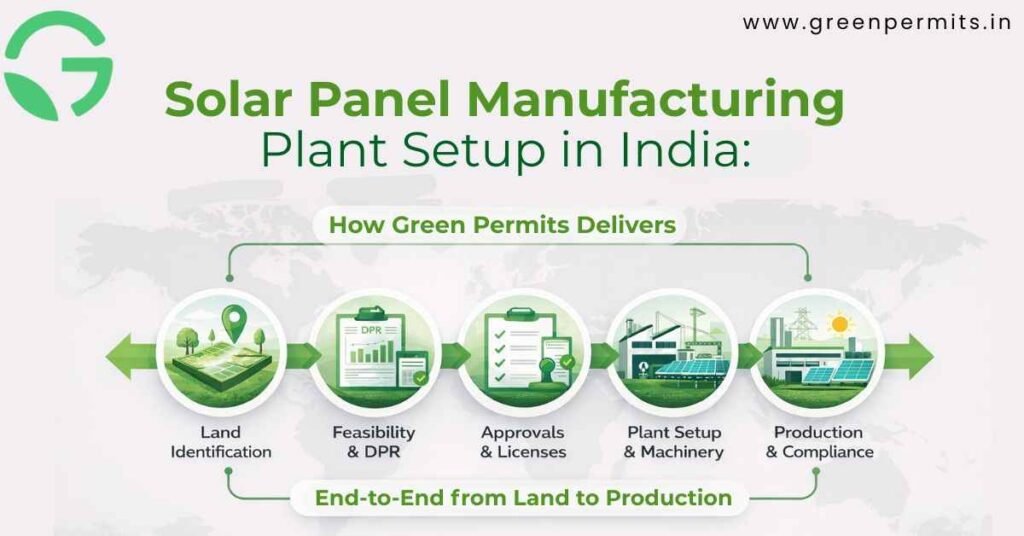
Green Permits follows a structured, compliance-first approach to plant setup. Instead of handling approvals in isolation, the entire process is integrated from planning to execution.
Support typically includes:
This approach helps businesses reduce approval timelines, avoid rejections, and achieve faster operational readiness.
Setting up a solar panel manufacturing plant in India requires more than technical expertise and capital investment. It demands a clear understanding of regulatory frameworks and precise execution of compliance requirements.
Projects that treat compliance as an afterthought often face delays, cost overruns, and operational challenges.
On the other hand, businesses that prioritize structured compliance from the beginning benefit from faster approvals, smoother operations, and stronger financial performance.
In a sector where every day of delay can cost lakhs, compliance is not just necessary — it is a competitive advantage.
📞 +91 78350 06182
📧 wecare@greenpermits.in