A listed electronics manufacturer proudly disclosed in its BRSR report that 95% of its waste was recycled.
But during a regulatory review, CPCB data showed:
- No matching EPR certificates
- No quarterly returns filed
- Waste routed through unregistered vendors
Within weeks:
- ESG audit observations were raised
- CPCB compliance flagged
- Risk of penalty under Section 15 of the Environment Protection Act emerged
This is the reality today.
BRSR reporting without regulatory alignment is now treated as non-compliance.
Introduction
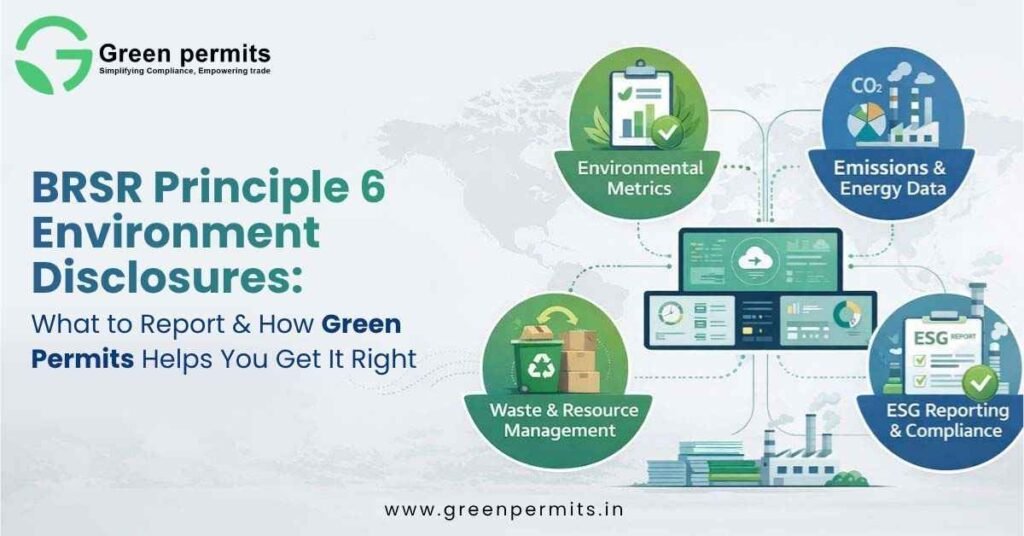
BRSR Principle 6 focuses on how businesses measure, manage, and disclose environmental impact across operations.
In 2025–2026, this is no longer a voluntary ESG exercise. It is tightly linked with:
- CPCB compliance systems
- EPR obligations across waste streams
- SPCB approvals and environmental permissions
Companies are expected to report:
- Verified data
- Portal-aligned numbers
- Certificate-backed recycling
Failure to align leads to audit failures, penalties, and operational risk.
What is BRSR Principle 6?
BRSR Principle 6 requires companies to disclose environmental performance across:
- Energy consumption
- Water usage
- Waste generation and disposal
- Air emissions
- Environmental compliance status
This data must reflect actual regulatory filings, not internal estimates.
Key Metrics Required
- Total waste generated (MT/year)
- % recycled vs disposed
- Water consumption (KL/year)
- Energy intensity (per unit output)
Regulatory Backbone Behind Principle 6
TABLE 1 – Regulatory Overview
| Regulation |
Requirement |
Deadline |
Applicable To |
Risk |
| E-Waste Rules 2022 |
EPR registration + returns |
Annual |
Electronics sector |
Portal rejection |
| PWM Amendment 2025 |
QR/barcode traceability |
Immediate |
Plastic users |
Penalty |
| Battery Rules 2025 |
EPR + labeling compliance |
Quarterly |
Battery producers |
Compliance failure |
| ELV Rules 2025 |
8%, 13%, 18% targets |
FY-based |
Auto sector |
Liability |
| EP Act 1986 |
Environmental compliance |
Continuous |
All industries |
Fine + imprisonment |
Interpretation
BRSR disclosures must match actual compliance under these laws.
Mismatch between ESG report and regulatory filings leads to:
- Compliance audits
- Legal exposure
- Investor distrust
What You Must Report Under Principle 6
1. Waste Management Disclosures
Waste reporting is the most critical component of Principle 6.
You must disclose:
- Hazardous vs non-hazardous waste
- Quantity recycled vs disposed
- EPR obligations fulfilled
Key Data Requirements
- EPR targets:
- 8% initial phase
- 13% mid-phase
- 18% long-term
- 100% recycling obligation for certain materials
Practical Reporting Structure
- Plastic introduced → EPR liability
- Waste processed → recycler certificates
- Net compliance → reflected in BRSR
2. EPR Compliance Integration
Under Indian regulations, producers must:
- Register on CPCB portal
- Declare annual obligations
- Purchase EPR certificates
- File returns (quarterly + annual)
Required Documents
- PAN, GST, CIN, IEC
- SPCB consent certificates
- Waste generation data
Key Insight
BRSR reporting must be certificate-backed, not assumption-based.
3. Energy & Emissions Reporting
Companies must report:
- Scope 1 emissions (direct fuel use)
- Scope 2 emissions (electricity consumption)
- Renewable vs non-renewable energy
Typical Benchmarks
- 20% to 40% renewable energy transition targets
- Year-on-year reduction in energy intensity
4. Water & Resource Management
Disclosures must include:
- Total water consumption
- % recycled or reused water
- Discharge practices
Industrial Benchmarks
- 1000 to 1500 KL/day for mid-size plants
- Increasing shift toward Zero Liquid Discharge systems
TABLE 2 – Compliance Timeline
| Step |
Authority |
Timeline |
Documents |
Risk |
| EPR Registration |
CPCB |
30 days |
GST, PAN, IEC |
Rejection |
| SPCB Consent (CTE/CTO) |
State Board |
60–90 days |
Plant details |
Shutdown |
| Quarterly Returns |
CPCB |
Every quarter |
EPR data |
Suspension |
| Annual Return Filing |
CPCB |
Yearly |
Waste data |
Penalty |
Interpretation
BRSR reporting must align with actual compliance timelines, not financial reporting cycles.
CPCB Portal Workflow (Critical for BRSR)
Environmental compliance today is portal-driven.
Step-by-Step Process
- Register on CPCB portal
- Upload company and waste details
- Declare EPR obligations
- Procure certificates from recyclers
- File quarterly returns
- Submit annual returns
Missing any step leads to data inconsistency in BRSR.
Compliance Risks & Penalties
Failure to align BRSR disclosures with actual compliance can result in:
- CPCB registration rejection
- Environmental compensation charges
- SPCB refusal for approvals
- Customs clearance delays
- Production stoppage
Legal Exposure
Under Section 15 of the Environment Protection Act:
- Monetary penalties
- Imprisonment risk
- Continuous liability for violations
Practical Business Scenarios
Scenario 1: ESG vs Compliance Mismatch
Company reports 100% recycling
- No EPR certificates available
- CPCB portal shows zero compliance
Result:
- Audit failure
- Regulatory scrutiny
Scenario 2: Missed Quarterly Returns
Company delays portal filings
- EPR targets not updated
- Annual report becomes inaccurate
Result:
- Portal restriction
- BRSR data mismatch
Scenario 3: Incorrect Waste Classification
Hazardous waste reported as general waste
Result:
- SPCB violation
- Environmental compensation
How Green Permits Helps You Get It Right
Green Permits bridges the gap between ESG reporting and actual compliance.
We support:
- CPCB EPR registration and filings
- Waste data structuring aligned with BRSR
- EPR certificate procurement
- SPCB approvals and documentation
- End-to-end compliance tracking
This ensures:
- Audit-ready BRSR reports
- Accurate environmental disclosures
- Zero regulatory mismatch
Conclusion
BRSR Principle 6 is no longer just about sustainability reporting.
It is a compliance validation framework that integrates:
- CPCB systems
- EPR mechanisms
- Waste management rules
Companies that align early benefit from:
- Faster regulatory approvals
- Lower compliance risk
- Strong ESG credibility
Those who delay face:
- Penalties
- Operational disruptions
- Investor scrutiny
Structured, regulation-backed reporting is now essential for business continuity.
📞 +91 78350 06182
📧 wecare@greenpermits.in
Book a Consultation with Green Permits
