
A solar module manufacturer finalized a 15-acre site in Rajasthan due to low land cost and attractive subsidy commitments. The project looked financially viable on paper with expected savings of nearly 20 percent on capital cost. However, due to incomplete SPCB documentation and delayed EPR registration, the Consent to Establish was rejected twice.
This resulted in a delay of more than 120 days and a cost escalation of approximately ₹7-9 crore. Machinery remained idle, interest costs increased, and investor confidence was impacted.
This situation highlights a critical reality. Incentives reduce cost, but compliance determines whether the plant actually starts on time.
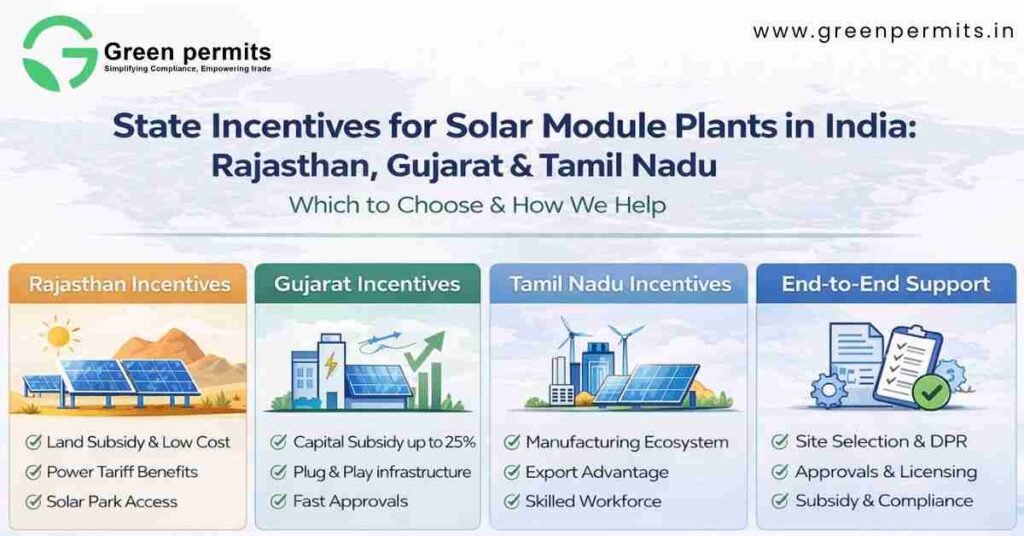
India is targeting more than 500 GW of renewable energy capacity by 2030, and solar manufacturing is a key pillar of this expansion. To support this, both central and state governments are offering financial incentives, infrastructure benefits, and policy support.
However, solar module manufacturing is not just a subsidy-driven opportunity. It is a compliance-intensive industrial project governed by multiple regulations such as:
A mismatch between incentives and compliance planning can lead to:
For most businesses, the challenge is not identifying incentives but aligning them with execution feasibility.
Choosing the right state is a strategic decision that impacts capital investment, operating cost, approval timelines, and long-term scalability.
Gujarat has emerged as one of the most preferred destinations for solar manufacturing due to its strong industrial base and proactive governance.
The state offers a combination of policy stability, infrastructure readiness, and faster approvals. Many large-scale solar manufacturers prefer Gujarat because it reduces operational uncertainty.
From a financial perspective, companies can reduce logistics costs by up to 15-20 percent due to port proximity. Additionally, industrial clusters reduce setup time by 30-40 percent.
At the same time, Gujarat has strict compliance monitoring, which means documentation must be accurate and timely.
Key advantages include:
Key considerations:
Rajasthan is often selected by companies that want to optimize capital expenditure and set up large-scale plants.
The availability of land at 30-50 percent lower cost compared to Gujarat makes it attractive for projects requiring 20-50 acres. For large manufacturing capacities above 1 GW, this becomes a significant advantage.
The state also provides strong fiscal incentives such as SGST reimbursement and stamp duty exemption. These benefits can reduce upfront cost by nearly 10-15 percent.
However, infrastructure readiness varies by region, and approval timelines can extend beyond 120 days if documentation is not properly aligned.
Key advantages:
Key challenges:
Tamil Nadu is a strong manufacturing hub with an established ecosystem for electronics and renewable energy industries.
For companies targeting export markets, Tamil Nadu offers a strategic advantage due to its port connectivity and supply chain ecosystem. The availability of skilled labor also improves operational efficiency by reducing downtime and training costs.
Production efficiency in Tamil Nadu plants is often 10-15 percent higher due to better workforce availability and industrial maturity.
However, compliance requirements are stringent, and land plus operational costs are higher compared to Rajasthan.
Key advantages:
Key challenges:
Solar manufacturing plants require multiple regulatory approvals before construction and operation. These approvals are not parallel but sequential, which means delay in one stage affects the entire project timeline.
| Regulation | Requirement | Deadline | Applicable To | Risk |
|---|---|---|---|---|
| E-Waste Rules 2022 | EPR Registration | Before production | Manufacturers | Sales restriction |
| SPCB Consent (CTE/CTO) | Setup and operation approval | 60-120 days | All plants | Closure notice |
| Hazardous Waste Rules 2016 | Waste authorization | Before operation | Chemical usage | Legal penalty |
| PWM Rules 2025 | Packaging compliance | Continuous | Packaging | EPA penalty |
Each approval requires detailed documentation, and incomplete submissions can lead to rejection.
In practice, companies face the following challenges:
To avoid delays, approvals must be planned from the project design stage itself.
The compliance timeline for solar manufacturing is structured and cannot be compressed beyond a certain limit due to regulatory dependencies.
| Step | Authority | Timeline | Documents | Risk |
|---|---|---|---|---|
| Land Identification | State Govt | 15-30 days | Land papers | Delay |
| CTE Approval | SPCB | 30-60 days | DPR, layout | Rejection |
| EPR Registration | CPCB | 30-45 days | GST, PAN, IEC | Sales ban |
| CTO Approval | SPCB | 30-60 days | Trial data | Shutdown |
| Production Start | Internal | Post approvals | Compliance docs | Legal risk |
In reality, most projects take between 120 to 180 days to become fully operational.
Key factors affecting timeline:
Solar modules are categorized under electronic waste, making Extended Producer Responsibility mandatory.
This means manufacturers are responsible for the end-of-life management of their products.
EPR compliance is not a one-time activity but an ongoing operational requirement. Companies must plan EPR obligations based on production volume and lifecycle assumptions.
Key compliance requirements include:
Operational challenges faced by companies:
Non-compliance leads to:
A solar module manufacturing plant requires detailed technical planning to ensure compliance and operational efficiency.
The investment and infrastructure requirements vary based on plant capacity.
Typical project parameters:
Waste management is a critical component, especially for:
Most plants must implement Zero Liquid Discharge systems to meet environmental norms.
Improper planning can lead to:
Solar manufacturing projects face significant risks if compliance is not properly managed.
Regulatory authorities monitor both setup and operational stages, and violations can lead to immediate action.
Key risks include:
Legal exposure:
These risks directly affect revenue, investor confidence, and long-term sustainability.
Selecting the right state requires a balance between incentives and compliance feasibility.
Businesses should evaluate:
There is no universally best state. The decision must be aligned with business objectives, scale, and compliance capability.
Solar manufacturing in India offers strong growth potential supported by government incentives. However, compliance remains the most critical success factor.
While incentives can reduce capital cost by up to 25 percent, delays due to non-compliance can increase costs by the same margin.
A structured approach involving:
ensures faster execution, lower risk, and long-term operational success.
📞 +91 78350 06182
📧 wecare@greenpermits.in