
A solar module manufacturer in western India invested nearly ₹180 crore to set up a 1 GW facility. The business model looked strong on paper because it included central incentives and state-level land benefits. However, the project was delayed by almost 150 days due to incomplete environmental approvals and CPCB registration.
This delay created a chain reaction across the project lifecycle. Loan disbursement slowed down, EPC contracts had to be renegotiated, and projected revenue for the first quarter was completely lost. In addition, the company incurred an additional interest burden of nearly 7 percent due to extended timelines.
This is not an isolated case. In most solar manufacturing projects, delays are not caused by funding gaps but by regulatory misalignment.
Key outcomes observed in such situations:
India’s push toward domestic solar manufacturing is driven by large-scale policy interventions. The government is targeting 500 GW renewable energy capacity by 2030, and manufacturing is a key pillar of this strategy. As a result, multiple subsidy schemes have been introduced to attract investment into the sector.
However, solar manufacturing is not just about installing machinery and claiming incentives. It is a regulated industry that falls under environmental, product, and waste management laws. Every stage of the project, from land acquisition to final production, is linked with compliance approvals.
In real-world projects, companies that focus only on subsidies often face operational delays. On the other hand, businesses that align subsidy planning with compliance planning achieve faster approvals and smoother execution.
From a practical standpoint, the success of a solar manufacturing plant depends on two parallel tracks:
Central government schemes are designed to build large-scale capacity and reduce dependency on imports. These incentives are structured in a way that rewards performance, efficiency, and domestic value addition.
The PLI scheme is the most significant financial support mechanism available for solar manufacturing in India. It is designed to encourage companies to invest in integrated manufacturing and improve production efficiency.
The scheme has a total outlay of more than ₹24,000 crore. It provides incentives based on actual sales and efficiency levels, which means companies benefit only when they produce and sell high-quality modules.
In a typical 1 GW project, PLI can improve project returns significantly by reducing the payback period by 2 to 3 years. The incentive is calculated as a percentage of net sales and is distributed over a period of 5 years.
Operationally, the scheme encourages:
Key financial and operational impacts:
Infrastructure is one of the major cost components in any manufacturing project. The Solar Park Scheme addresses this challenge by providing financial assistance for infrastructure development.
The scheme supports internal infrastructure such as roads, drainage systems, and grid connectivity. Financial assistance is provided at approximately ₹20 lakh per MW, which can significantly reduce upfront investment.
For a large project of 1 GW capacity, this translates into a substantial cost advantage. It also reduces the time required for site preparation and connectivity.
From a practical perspective, the scheme helps in:
The introduction of Basic Customs Duty has reshaped the solar manufacturing landscape in India. By imposing duties on imported modules and cells, the government has created a protective environment for domestic manufacturers.
This policy ensures that locally manufactured products remain competitive in the market. It also encourages companies to invest in domestic production instead of relying on imports.
The impact of this policy is clearly visible in the market:
Key duty structure:
The Approved List of Models and Manufacturers acts as a regulatory filter for market participation. Even if a company sets up a plant and produces modules, it cannot supply to government projects without ALMM approval.
This makes ALMM compliance a critical requirement for revenue generation.
From a business standpoint:
Central incentives play a critical role in shaping project economics. However, they are tightly linked to compliance and performance.
Important observations:
State policies add another layer of financial advantage to solar manufacturing projects. These incentives vary across states and can significantly impact overall project cost and profitability.
Gujarat has emerged as one of the most preferred destinations for solar manufacturing due to its strong industrial ecosystem and policy support.
The state offers a combination of financial incentives and operational advantages. Land subsidies, electricity duty exemptions, and power tariff support make Gujarat a cost-effective location for large-scale projects.
In addition to financial benefits, Gujarat provides:
Key benefits available in Gujarat:
Rajasthan offers significant cost advantages, particularly in terms of land and infrastructure. The state’s solar policy is designed to attract large-scale investments by reducing project costs.
The availability of large land parcels and policy incentives makes Rajasthan suitable for mega projects above 1 GW capacity.
From a financial perspective, companies can achieve considerable savings through:
These incentives can reduce project cost by ₹25 crore to ₹40 crore depending on the size of the plant.
Tamil Nadu focuses on high-value manufacturing and export-oriented industries. The state provides strong policy support for companies looking to manufacture advanced solar products.
The presence of skilled labor and established industrial clusters makes Tamil Nadu suitable for technologically advanced manufacturing units.
Key advantages include:
State incentives play a crucial role in determining project viability. Choosing the right state can significantly improve financial outcomes.
Important considerations:
| Regulation | Requirement | Deadline | Applicable To | Risk |
|---|---|---|---|---|
| E-Waste Rules 2022 | CPCB registration | Before operation | Solar manufacturers | Plant shutdown |
| Plastic Waste Amendment 2025 | Barcode and EPR ID | From 01 July 2025 | Packaging | Market restriction |
| Environment Protection Act 1986 | Environmental clearance | Before setup | All plants | Legal penalty |
| SPCB Consent | CTE and CTO approval | Before commissioning | Manufacturing units | Project delay |
Regulatory approvals are not optional. They are directly linked to project execution and subsidy eligibility.
In practice:
Failure to meet these requirements leads to delays and financial losses.
| Step | Authority | Timeline | Documents | Risk |
|---|---|---|---|---|
| DPR and land approval | State Govt | 30 to 60 days | DPR, layout | Subsidy delay |
| SPCB Consent (CTE) | SPCB | 45 to 90 days | Pollution plan | Project hold |
| CPCB Registration | CPCB | 30 to 60 days | GST, PAN, IEC | Rejection |
| BIS Certification | BIS | 60 to 120 days | Test reports | Product ban |
| Final commissioning | Multiple | 120 to 180 days | All approvals | Revenue delay |
Projects that integrate compliance with planning achieve faster timelines. Delays in any one approval can push the entire project schedule.
Key observations:
Solar manufacturing involves lifecycle responsibility, which is regulated under EPR requirements. This means manufacturers must account for the disposal and recycling of their products.
The CPCB registration process ensures that companies are accountable for environmental impact throughout the product lifecycle.
The registration process is structured but requires careful documentation. Companies must provide detailed information about their operations and compliance plans.
The process includes:
Key documentation requirements:
Once registered, companies must maintain continuous compliance through regular reporting.
This includes:
Failure to maintain proper compliance leads to operational and financial risks.
Key risks include:
EPR compliance is an ongoing responsibility. It requires structured planning and execution.
Important points:
Setting up a solar manufacturing plant requires careful planning of technical, financial, and environmental aspects.
A typical plant involves large-scale investment and infrastructure.
Common parameters include:
Environmental compliance is a critical part of plant setup. Poor planning can lead to rejection or delays.
Key requirements include:
Plant design and compliance planning must be aligned from the beginning.
Important considerations:
Non-compliance can disrupt operations and affect financial performance. Regulatory authorities impose strict penalties for violations.
From a legal perspective, companies must adhere to environmental and compliance laws at all stages.
Common risks include:
Under the Environment Protection Act:
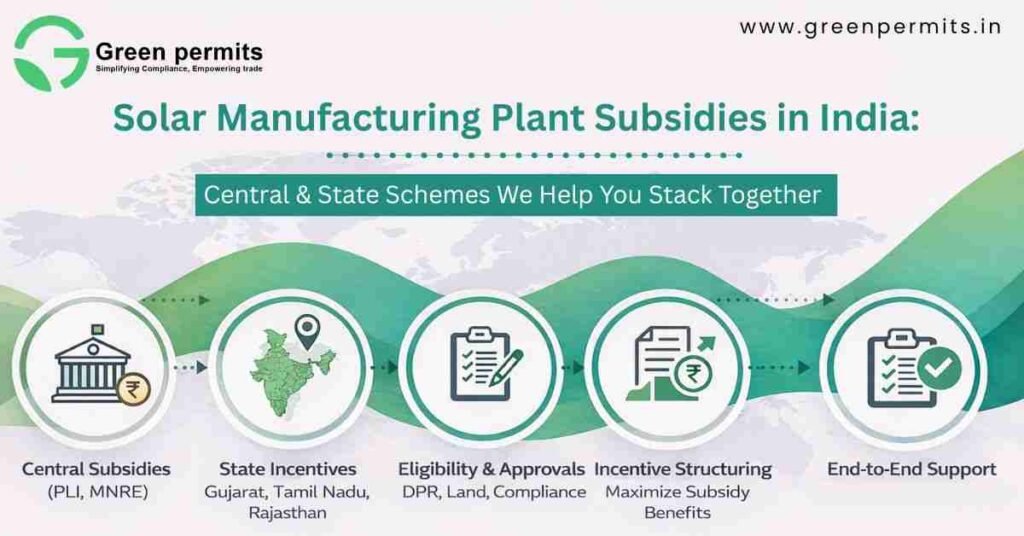
Solar manufacturing subsidies in India provide strong financial support, but they must be aligned with regulatory compliance.
From a strategic perspective:
Companies that integrate both aspects achieve better outcomes in terms of timeline, cost, and revenue.
📞 +91 78350 06182
📧 wecare@greenpermits.in