
A recycling business can fail even after buying land, installing machinery, hiring manpower, and arranging raw material supply. The reason is simple – in India, a recycling plant cannot start operations only because the plant is physically ready. It must first clear multiple regulatory approvals from CPCB, SPCB, local authorities, and other departments depending on the waste category.
This is where many entrepreneurs face delays. A plant owner may spend ₹50 lakh, ₹2 crore, or even ₹20 crore on machinery, but if the Consent to Establish, Consent to Operate, waste authorization, EPR registration, or portal filing is incomplete, the project can remain stuck for months.
Recycling plant compliance in India is now more detailed than before. Regulators are not only checking whether a plant exists. They are checking whether the plant has proper land documents, approved layout, pollution control systems, capacity details, waste storage areas, worker safety systems, process flow diagrams, and online registration under the applicable waste rules.
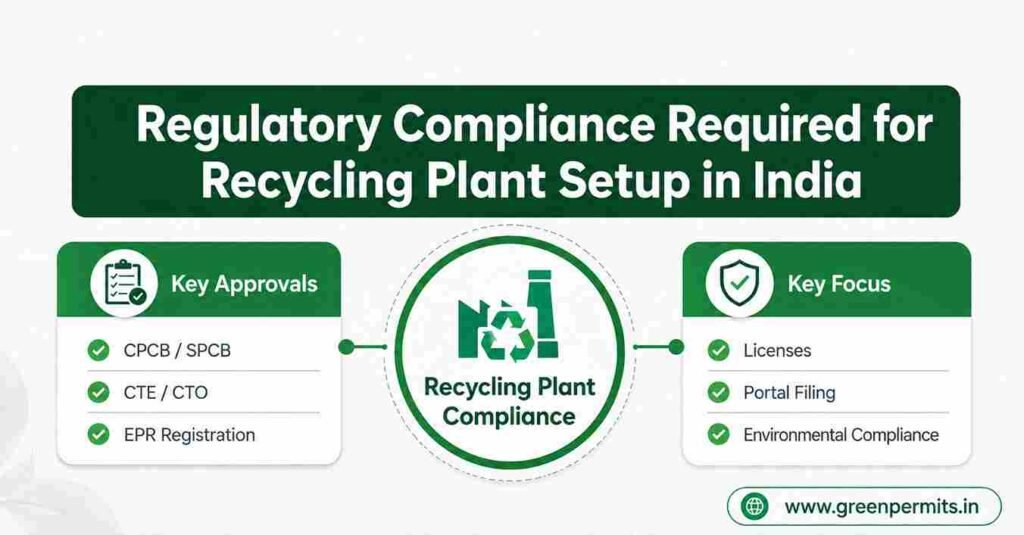
For e-waste, plastic waste, battery waste, and end-of-life vehicle recycling, compliance is no longer a one-time approval. It is an ongoing responsibility involving registration, returns, certificates, capacity reporting, EPR obligations, and renewal timelines.
A small error such as mismatch in GST details, wrong capacity entry, missing geo-tagged photo, incomplete CTO condition, or late return filing can lead to rejection, portal suspension, environmental compensation, or business interruption.
A recycling plant handles waste streams that may include metals, plastics, batteries, wires, glass, rubber, oils, acids, sludge, wastewater, dust, electronic parts, and hazardous residues. Because of this, recycling is treated as an environmentally sensitive activity, not a simple manufacturing business.
Before starting operations, the project owner must prove that the plant will not pollute air, water, land, workers, or nearby communities. This proof is created through a combination of technical documents, pollution control systems, statutory approvals, and online portal registration.
For example, an e-waste recycling plant normally requires CTE and CTO from the State Pollution Control Board, authorization under Hazardous and Other Waste Rules, and registration on the CPCB e-waste portal. The plant must also provide capacity details in tonnes per year, details of machinery, geo-tagged photos, geo-tagged video, and a material recovery plan.
Similarly, a plastic waste recycling plant must show its process flow, washing system, water consumption, reject waste, ETP design, air pollution control system, and final recycled product details. A battery recycling plant must show chemistry-wise handling, hazardous waste management, recovered metal details, and safety controls.
This means compliance should start at the planning stage, not after installation.
Important compliance points:
| Regulation | Main Requirement | Deadline / Validity | Applicable To | Business Risk |
|---|---|---|---|---|
| Water Act, 1974 | Consent to Establish and Consent to Operate | Before construction and operation | All recycling plants using water or process activity | SPCB refusal, closure direction |
| Air Act, 1981 | Consent for emissions, DG sets, boilers, shredders, furnaces | Before installation and operation | Plants with air emissions | Production halt, penalty |
| Environment Protection Act, 1986 | Compliance with waste rules and environmental directions | Continuous | All regulated recycling units | Liability under Section 15 |
| Hazardous and Other Wastes Rules, 2016 | Authorization for hazardous residue handling | Before handling hazardous waste | E-waste, battery, ELV, chemical-linked recycling | Waste disposal violation |
| E-Waste Management Rules, 2022 | CPCB registration and EPR certificate framework | Effective from 1 April 2023 | Producers, manufacturers, recyclers, refurbishers | Portal rejection, suspension |
| Plastic Waste Management Rules, 2016 and 2025 Amendment | PIBO/PWP registration, EPR compliance, QR/barcode requirement | QR/barcode rule from 1 July 2025 | PIBOs, plastic recyclers, PWPs | EPR default, sales restriction |
| Battery Waste Management Rules, 2022 and 2025 Amendment | Battery producer and recycler registration | 2025 amendment notified on 24 February 2025 | Battery producers, importers, recyclers | Import and sales risk |
| ELV Rules, 2025 | Producer, RVSF, and bulk consumer registration | Notified on 6 January 2025, effective from 1 April 2025 | Vehicle producers, RVSFs, bulk consumers | Certificate and portal risk |
| Factory License | Worker safety and factory operation approval | Before commercial operation | Industrial recycling plants | Labour and safety non-compliance |
| Fire NOC | Fire safety approval | Before operation, depending on state rules | Plants storing combustible waste | Fire risk, license delay |
The main point is that one approval is not enough. A recycling project usually needs land approval, DPR, CTE, pollution control design, waste authorization, factory and fire approvals, CTO, CPCB or SPCB registration, and return filing compliance.
E-waste recycling is regulated under the E-Waste Management Rules, 2022. These rules became effective from 1 April 2023 and replaced the earlier 2016 framework. The rules cover 4 main entities – manufacturer, producer, refurbisher, and recycler.
An e-waste recycler must register on the CPCB portal before carrying out regulated recycling activity. If a business falls under more than one category, such as refurbisher and recycler, separate registration may be required.
The recycler registration is generally valid for 5 years. In case CPCB finds the application incomplete, the shortcomings are communicated through the portal. The applicant is usually required to respond within 7 working days after receiving the deficiency.
For e-waste recyclers, the most important compliance element is capacity. The capacity declared on the CPCB portal should match the Consent to Operate, installed machinery, plant layout, and actual processing capability. If a recycler claims 3,000 MT/year capacity but the machinery and CTO support only 1,500 MT/year, the application may face objection.
A compliance-ready e-waste recycling plant should include proper dismantling tables, storage areas, dust control systems, hazardous waste storage, fire safety arrangements, worker safety systems, and recovery process details.
Key requirements include:
E-waste EPR certificates are linked with recovered materials such as gold, copper, aluminium, and iron. This makes accurate material balance very important. If the recycler cannot justify input waste, output recovery, rejects, and residue disposal, the certificate generation process can become risky.
Plastic recycling plants are regulated under the Plastic Waste Management Rules, 2016, along with later amendments. The 2025 amendment added more compliance focus on product information, barcode or QR code disclosure, and traceability.
From 1 July 2025, specified information requirements for plastic packaging become more important for producers, importers, and brand owners. This means plastic recycling and plastic EPR compliance will become more data-driven.
A plastic waste processor or recycler must register through the relevant EPR portal. Plastic Waste Processors include recyclers, waste-to-energy plants, co-processing facilities, plastic waste-to-oil units, and industrial composting facilities.
For a plastic recycling plant, SPCB usually checks whether the plant has a defined process flow. For example, collection, sorting, washing, shredding, drying, extrusion, pelletizing, testing, packaging, and reject disposal. If washing is involved, the plant must show water consumption and effluent treatment planning.
A 5 MT/day plastic recycling plant may have very different compliance requirements compared to a 50 MT/day plant. Higher capacity means larger storage area, higher water requirement, bigger ETP, stronger fire safety planning, and stricter waste tracking.
Key requirements include:
The DPR for a plastic recycling plant should not only show business profitability. It should also show land area, power load, machinery capacity, water use, wastewater generation, reject percentage, ETP design, pollution control equipment, manpower, and approvals required.
Battery waste recycling is governed by the Battery Waste Management Rules, 2022, with a 2025 amendment notified on 24 February 2025. Battery waste compliance is more sensitive because batteries may contain lead, lithium, nickel, cobalt, cadmium, manganese, electrolyte, acid, plastic, and other hazardous components.
The rules cover all types of batteries regardless of chemistry, shape, volume, weight, material composition, and use. This includes lead-acid batteries, lithium-ion batteries, nickel-cadmium batteries, zinc-based batteries, portable batteries, automotive batteries, industrial batteries, and EV batteries.
Battery producers, manufacturers, importers, recyclers, and refurbishers are required to register on the relevant portal. Producers must meet EPR obligations by obtaining EPR certificates from registered recyclers or refurbishers.
A battery recycler must have proper dismantling, segregation, storage, and material recovery systems. For lead-acid battery recycling, air pollution control, acid handling, lead dust control, worker safety, and hazardous waste disposal are critical. For lithium-ion battery recycling, fire safety, thermal risk, chemistry-wise segregation, and safe storage become very important.
Battery EPR certificates are generated based on recovered key battery materials. For example, lead is important in lead-acid batteries, while lithium, nickel, manganese, cobalt, aluminium, iron, and copper may be relevant for lithium-ion batteries.
Key requirements include:
For a battery recycling plant, the DPR should include plant capacity in MT/day, chemistry-wise input, expected recovery, pollution control equipment, hazardous waste handling, manpower, investment cost, and safety measures.
The Environment Protection End-of-Life Vehicles Rules, 2025 were notified on 6 January 2025 and came into force from 1 April 2025. These rules are important for vehicle producers, Registered Vehicle Scrapping Facilities, bulk consumers, collection centres, automated testing stations, and businesses involved in vehicle dismantling or scrapping.
Under these rules, RVSFs are not only scrapping units. They are also part of the EPR certificate ecosystem. RVSFs generate EPR certificates based on the quantity of steel recovered from end-of-life vehicles. Vehicle producers then purchase these certificates to meet their EPR obligations.
The ELV framework has fixed EPR targets:
| Financial Year | EPR Target | Basis |
|---|---|---|
| FY 2025-26 to FY 2029-30 | Minimum 8% | Steel used in applicable vehicles |
| FY 2030-31 to FY 2034-35 | Minimum 13% | Steel used in applicable vehicles |
| FY 2035-36 onward | Minimum 18% | Steel used in applicable vehicles |
This is a major shift for the auto sector. Vehicle producers must now plan EPR obligations, certificate purchase, return filing, and portal compliance. RVSFs must maintain accurate steel recovery data and ensure that depollution, dismantling, storage, and disposal are carried out properly.
An RVSF must manage hazardous components such as fuel, oils, coolants, batteries, airbags, tyres, lamps, electronic parts, plastics, and fluids before dismantling or shredding the vehicle.
Key RVSF compliance requirements include:
If an RVSF is not portal-ready, it may lose business from producers who need valid certificates. This can directly affect revenue even if the physical scrapping facility is operational.
| Step | Authority | Expected Timeline | Key Documents | Risk |
|---|---|---|---|---|
| 1. Project feasibility and DPR | Consultant / internal team | 2-4 weeks | Capacity, cost, land, machinery, process flow | Wrong capacity planning |
| 2. Land and zoning check | Local body / industrial authority | 1-3 weeks | Land papers, zoning certificate, layout | Site rejection |
| 3. Consent to Establish | SPCB / PCC | 30-90 days | DPR, layout, process, water balance, APCD/ETP plan | Construction delay |
| 4. Factory and fire approval | Factory department / fire department | 30-60 days | Safety plan, layout, fire system | License delay |
| 5. Machinery installation | Plant owner | Project-specific | Machinery invoices, installation photos | Capacity mismatch |
| 6. Consent to Operate | SPCB / PCC | 30-90 days | CTE compliance, test reports, photographs | Operation halt |
| 7. Waste-specific registration | CPCB / SPCB portal | 25-60 working days | PAN, GST, CIN, IEC, CTE, CTO, HWM authorization | Portal rejection |
| 8. EPR certificate readiness | CPCB portal | After approval | Recovery data, certificate data, capacity records | No certificate generation |
| 9. Quarterly and annual returns | CPCB / SPCB portal | Periodic | Sales data, waste data, certificates, awareness data | Suspension risk |
| 10. Renewal and amendment | CPCB / SPCB | Before expiry or change | Revised documents, fee, justification | Compliance gap |
A recycling project should not apply randomly for approvals. The sequence matters. If CTE is delayed, civil work is delayed. If CTO is delayed, operation is delayed. If portal registration is delayed, EPR certificate generation is delayed. If returns are missed, registration can be affected.
Most recycling categories now follow online filing. CPCB and SPCB portals are used not only for registration but also for tracking returns, capacity, EPR obligations, certificates, and compliance records.
The typical portal journey starts with account creation. The applicant selects the category, fills company details, adds authorized person details, enters facility details, uploads documents, pays fees, submits the application, responds to deficiencies, and receives registration through the portal.
For many categories, the applicant must ensure that the company name, GST, PAN, CIN, IEC, and registered address match across all documents. Even a small mismatch can create a query.
For return filing, producers and recyclers must be careful about sequence. Quarterly returns should be filed in order. Annual return filing may require additional data such as awareness activities, sales data, EPR certificates, waste processed, and compliance declarations.
Practical filing sequence:
The biggest risk in recycling plant compliance is not only financial penalty. The bigger risk is business stoppage. If a plant cannot operate, cannot generate certificates, cannot receive waste, or cannot sell recycled material, the entire project economics can collapse.
A plant may face rejection if the application is incomplete, if capacity does not match CTO, if documents are not uploaded properly, or if pollution control systems are not adequate.
A recycling unit may also face regulatory action if it deals with unregistered entities, disposes waste illegally, submits false data, or fails to file returns.
Common risks include:
For importers, the risk can be even higher. If EPR registration is not available for covered products such as batteries, electronics, plastic packaging, or vehicles, shipment clearance and market sale may be affected.
A DPR for a recycling plant should not be prepared like a simple investment note. It should work as a technical, financial, and compliance document. It should help in bank funding, CTE approval, CTO approval, machinery planning, pollution control design, and portal registration.
For example, if the proposed plant capacity is 20 MT/day, the DPR should clearly show whether the machinery, land area, power load, storage area, manpower, pollution control system, and water requirement support that capacity.
A strong DPR should include:
For larger recycling plants, the DPR may also need input-output ratios, recovery rates, reject percentage, sludge generation, utility load, transformer size, backup power, internal road movement, and environmental monitoring plan.
The exact list depends on the type of recycling plant, but most projects need a common compliance file.
Documents usually required include:
The document file should be prepared before application filing. Many delays happen because companies start collecting documents after the portal application has already been submitted.
Many recycling projects become expensive because compliance is handled too late. If the site is wrong, the layout is weak, the machinery capacity is mismatched, or the pollution control system is missing, the project owner may need to redesign the plant.
Early compliance can reduce approval delays by 30-60 days in many cases. It also prevents avoidable costs such as reapplication, layout revision, additional civil work, idle machinery, delayed production, and consultant rework.
For a medium-scale recycling plant, even a 2-month delay can affect rent, EMI, staff salary, electricity demand charges, raw material contracts, and buyer commitments. This is why compliance should be built into the project plan from the first stage.
Early compliance helps in:
Recycling plant compliance in India is now a serious business requirement. It is not just paperwork. It directly affects investment safety, approval timelines, operational continuity, EPR certificate generation, buyer confidence, and long-term profitability.
A successful recycling plant must be planned with proper DPR, CTE, CTO, CPCB or SPCB registration, pollution control systems, waste authorization, capacity mapping, portal filing, and return compliance.
The cost of early compliance is much lower than the cost of rejection, suspension, environmental compensation, or plant shutdown. Businesses planning e-waste, plastic waste, battery waste, or ELV recycling should complete compliance planning before investing heavily in machinery and construction.
For manufacturers, importers, brand owners, recyclers, RVSFs, MSMEs, and corporates, the best approach is clear – structure compliance first, then scale the recycling business.
📞 +91 78350 06182
📧 wecare@greenpermits.in
Book a Consultation with Green Permits