
A recycling company may buy land, finalize machinery, and start civil work, but the project can still face delay if the plant layout for recycling facility does not match the declared capacity, process flow, pollution control system, and CPCB/SPCB compliance requirements.
This is a common approval-stage problem. A unit may declare 10 MT/day recycling capacity, but the layout may not show enough raw material storage, waste segregation space, ETP area, fire access, hazardous waste room, finished goods storage, or internal vehicle movement. During CTE, CTO, CPCB portal review, or inspection, this mismatch can lead to technical queries, approval delay, certificate restriction, or even refusal.
For recycling businesses in India, plant layout is not only a drawing. It is a compliance file. It shows how waste will enter the facility, how it will move through processing stages, how pollution will be controlled, how workers will be protected, and how recovered material will be stored and dispatched.
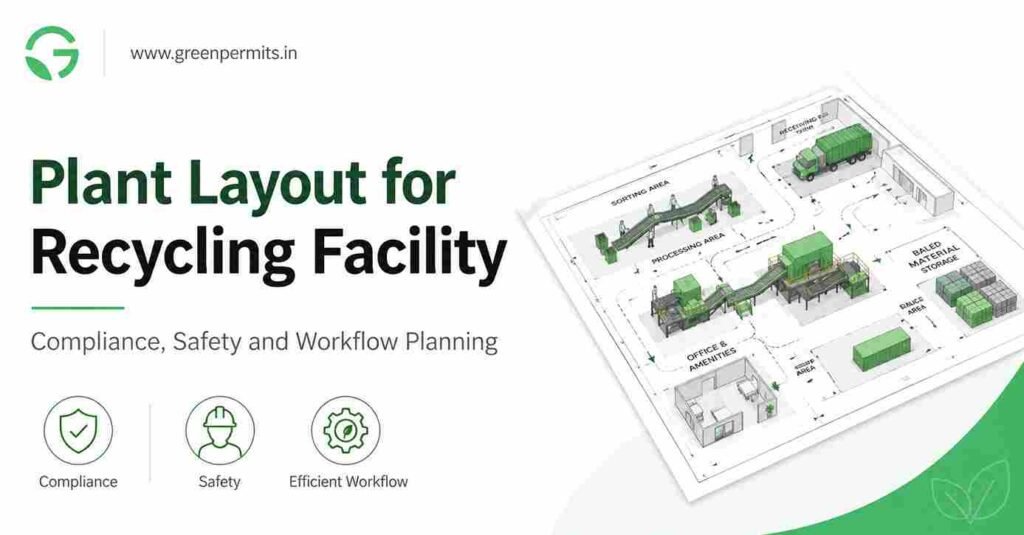
A well-planned recycling facility layout helps reduce approval risks and operational problems. It connects engineering design with environmental compliance, safety planning, EPR obligations, and future scalability.
A recycling facility deals with waste materials that may include plastic waste, e-waste, waste batteries, metal scrap, tyres, used oil, hazardous residues, wastewater, sludge, dust, fumes, or non-recyclable rejects. If these materials are not properly segregated in the layout, the facility can create environmental and safety risks.
Regulators examine whether the physical facility can support the activity declared in the application. For example, if a plastic waste processor claims washing and pelletizing, the layout must show sorting, washing, shredding, drying, extrusion, pelletizing, ETP, sludge handling, raw waste storage, and finished product storage. If an e-waste recycler declares material recovery capacity, the layout must support dismantling, segregation, machinery installation, dust control, hazardous storage, and safe dispatch.
A poor layout creates practical problems after approval. Trucks may block internal roads, raw waste may mix with finished products, fire exits may be blocked, wet processing areas may be placed near electrical panels, and hazardous fractions may be stored in open areas. These issues can affect CTO approval, fire NOC, insurance, worker safety, and client audits.
For recycling plant setup, layout should be finalized before machinery purchase and civil construction. Once foundations, sheds, drains, utility lines, and machinery positions are fixed, correcting compliance gaps becomes expensive and time-consuming.
Important layout approval points include:
A compliance-based layout explains the complete movement of waste inside the plant. It starts from the entry gate and ends at finished goods dispatch or authorized disposal of rejects. Every step should be visible in the plant drawing and supported by the DPR, process flow diagram, machinery list, material balance, and pollution control plan.
The layout must also reflect the applicable waste management rule. Plastic recycling, e-waste recycling, battery recycling, and vehicle scrapping have different compliance expectations. A plastic plant may need a larger wet processing and ETP area. An e-waste unit may need dismantling benches, dust extraction, and secure component storage. A battery recycling facility may need strict segregation, fume control, fire safety, and hazardous waste storage. An RVSF needs depollution, dismantling, steel recovery, used oil handling, tyre storage, plastic segregation, and battery/e-waste channelization.
The urgency is higher because 2025 and 2026 compliance frameworks increasingly depend on portal-based registration, geo-tagged facility evidence, capacity declaration, EPR certificate generation, and return filing. If the layout does not match the uploaded data, the application may face queries or later inspection issues.
For businesses, the objective should not be to prepare a drawing only for submission. The objective should be to prepare a layout that can survive scrutiny during CTE, CTO, CPCB/SPCB registration, audit, inspection, customer due diligence, and future expansion.
A good layout should answer:
| Regulation | Requirement | Deadline | Applicable To | Risk |
|---|---|---|---|---|
| Water Act, 1974 | Consent to Establish and Consent to Operate for water pollution control | Before setup and operation | Units using water, washing, treatment or discharge | CTE/CTO refusal, project delay |
| Air Act, 1981 | Consent for emissions, dust, fumes, boilers, furnaces, DG sets and air pollution systems | Before setup and operation | Plastic, e-waste, battery, metal and RVSF units | CTO delay, closure direction |
| Environment Protection Act, 1986 | Parent law for waste management rules and environmental protection directions | Ongoing | All recycling and waste management units | Liability under Section 15 and environmental compensation |
| E-Waste Management Rules, 2022 | Registration, capacity declaration, process flow, machinery details and EPR framework | Before business activity | E-waste recyclers, producers, refurbishers and manufacturers | Registration rejection or suspension |
| Plastic Waste Management Rules, 2016 with 2025 amendment | Registration of plastic waste processors, process flow, installed capacity and returns | Before processing plastic waste | Plastic recyclers, PWPs, PIBOs | EPR certificate restriction and portal risk |
| Battery Waste Management Rules, 2022 with 2025 amendment | Battery recycler registration, capacity, geo-images, battery category and EPR certificate mechanism | Before recycling and certificate generation | Battery recyclers, refurbishers and producers | Environmental compensation and certificate blockage |
| ELV Rules, 2025 | RVSF registration, ELV depollution, steel recovery capacity, EPR certificate generation and returns | Effective from 01 April 2025 | RVSFs, producers and bulk consumers | Portal rejection, EPR non-compliance, EC |
| Hazardous and Other Wastes Rules, 2016 | Authorization for hazardous waste handling, storage, transportation and disposal | Before handling hazardous waste | Battery, e-waste, RVSF and metal recyclers | Illegal storage, TSDF liability, EC |
The main interpretation is clear. A plant layout should not be prepared as a simple building plan. It should be prepared as a regulatory map showing capacity, storage, pollution control, material movement, safety systems and disposal routes.
Every recycling facility should be divided into functional zones. These zones help regulators, auditors, workers, customers and management understand the process clearly. If the zones are not defined, daily operations become unsafe and approval documentation becomes weak.
The first zone should include entry gate, security, weighbridge and administrative control. This area records incoming waste, supplier details, vehicle data, and quantity received. For larger facilities, a separate quarantine area may be needed for rejected, mixed, wet, damaged or non-conforming waste.
The second zone should be raw material storage. This must be sized according to daily capacity and storage days. For example, a 10 MT/day unit storing 7 days of raw material may require planned space for nearly 70 MT of input waste, excluding movement and safety space. If storage capacity is not realistic, material may spill into processing or movement areas.
The third zone is processing. This includes sorting, dismantling, washing, shredding, separation, refining, pelletizing, baling, depollution or recovery activities depending on the waste stream. The machinery location must match the process flow and allow maintenance access, worker safety and internal movement.
A compliance-ready layout should include:
Capacity planning is one of the most critical parts of layout design. If the layout supports only 5 MT/day but the application declares 20 MT/day, the project may face technical queries. Authorities may compare declared capacity with machinery rating, working hours, number of shifts, storage space, power load, water consumption, CTO capacity and pollution control design.
For plastic recycling plants, capacity depends on sorting efficiency, washing requirement, shredder rating, extruder output, drying system, water recycling and storage area. A dry plastic recycling unit and a PET washing unit of the same MT/day capacity will have different layout needs because washing creates wastewater, sludge and wet movement zones.
For e-waste recycling plants, capacity depends on dismantling benches, manpower, storage racks, shredders, separators, dust collectors, material recovery systems and hazardous waste area. The layout must show enough space for separate storage of PCB, cables, plastics, metals, glass, batteries, toner cartridges, lamps and non-recyclable residues.
For battery recycling units, capacity depends on battery type, category of recycler, dismantling line, pre-treatment equipment, black mass handling, metal recovery, fume control, fire safety and hazardous storage. A lead acid battery recycler, lithium-ion dismantler and black mass refiner cannot use the same layout logic.
Indicative planning points include:
A recycling plant should ideally follow one-way movement. Waste should enter from one side, move through defined processing stages, and exit as recovered material, finished product, by-product or authorized waste. Reverse movement increases contamination, fire risk, manpower conflict and inspection objections.
For plastic recycling, the workflow may follow raw waste receipt, sorting, washing, shredding, drying, extrusion, pelletizing, packing and dispatch. Wet processing should be separated from electrical rooms, finished goods and dry raw material storage. Wash water should move through proper drains to the ETP.
For e-waste recycling, the workflow may follow receipt, weighing, secure storage, dismantling, component segregation, shredding, separation, recovery, hazardous waste storage and dispatch. Sensitive components such as batteries, lamps, toner, PCBs and hazardous fractions should have separate bins and storage areas.
For RVSF projects, the workflow should include vehicle receipt, documentation, depollution, fluid removal, battery removal, tyre removal, dismantling, baling or shredding, steel recovery, waste segregation and dispatch to authorized recyclers. The depollution area must be designed with impervious flooring and spill control.
Workflow planning should define:
Pollution control systems should be part of the plant layout from the beginning. They should not be added as an afterthought after machinery installation. If the ETP, STP, scrubber, dust collector, fume extraction or hazardous waste room is not shown in the layout, approval queries become likely.
Plastic washing units may require an ETP with screening, settling, filtration, sludge handling and treated water reuse. If the project claims Zero Liquid Discharge, the layout must include treated water storage, recirculation lines, sludge drying or filter press area, and reject handling. The water balance must support the declared capacity.
E-waste and battery recycling facilities may require dust collectors, scrubbers, fume extraction, bag filters, wet scrubbers, local exhaust ventilation and stack monitoring points. These systems need duct routing, safe stack location, maintenance access and monitoring platforms.
RVSFs may need oil-water separators, used oil storage, coolant collection, fuel handling, battery storage, tyre storage, impervious flooring and separate drainage. Fluids removed during depollution should never mix with stormwater drains or soil.
Pollution control layout should include:
Recycling facilities can carry serious fire and occupational risks. Plastic waste is combustible. Lithium-ion batteries can create thermal runaway risk. E-waste dismantling can create dust and sharp-edge injuries. Vehicle scrapping involves fuel, oil, coolants, gas cylinders, airbags and heavy metal parts. Battery recycling may involve acid, lead, fumes and high-risk chemical handling.
A safety-focused layout reduces operational accidents and strengthens fire NOC, factory license, insurance and customer audit readiness. Emergency exits, fire hydrants, extinguishers, access roads, PPE stations, first-aid room, eyewash points, spill kits and emergency assembly area should be clearly marked.
High-risk zones should be physically separated. Incoming battery storage should not be placed near hot work or shredding. Used oil and fuel should not be stored near electrical panels. Hazardous waste should not be kept in open, unpaved or mixed storage areas. Fire tender access should not be blocked by raw material or finished goods.
Occupational health should be built into the design. Adequate ventilation, lighting, dust control, safe walkways, machine guarding, noise control and PPE access are important for daily operations and inspection.
Safety layout should include:
| Step | Authority | Timeline | Documents | Risk |
|---|---|---|---|---|
| Site and feasibility screening | Internal review / consultant | 7 to 15 days | Land details, waste stream, capacity estimate, zoning check | Wrong land selection |
| Layout and DPR preparation | Project consultant | 15 to 30 days | Plant layout, process flow, machinery list, utilities, cost estimate | Redesign after machinery advance |
| Consent to Establish | SPCB/PCC | 30 to 90 days, varies by state and category | Layout, land proof, PFD, pollution control plan, water and power details | CTE query or rejection |
| Civil construction and machinery installation | Project owner | 2 to 6 months, depending on scale | Approved layout, vendor drawings, foundation plan | Non-compliant construction |
| Consent to Operate | SPCB/PCC | 30 to 90 days, varies by inspection | Installed machinery, ETP/APCD proof, safety documents, trial data | CTO refusal or delay |
| CPCB/SPCB portal registration | CPCB or SPCB/PCC | 15 to 30 working days, depending on category | Portal form, geo-tagged evidence, capacity data, documents | Registration rejection |
| Inspection or audit | CPCB/SPCB/PCC | Before or after registration, as applicable | Site evidence, records, returns, photos, videos and compliance files | Suspension, EC or certificate hold |
| Return filing | CPCB/SPCB portal | Quarterly or annual, as applicable | Quantity processed, certificates, awareness data, waste transfer records | Portal non-compliance |
The timeline shows why layout should be prepared early. If the layout is corrected after CTE or after machinery installation, the project may lose months in redesign, construction modification, fresh drawings, and authority replies.
The plant layout should be supported by technical and regulatory documents. Authorities do not review the layout alone. They compare it with the process flow diagram, DPR, machinery list, water balance, material balance, waste generation details, pollution control design and land documents.
For plastic processors, geo-tagged images of raw material storage, production area, product dispatch area and machinery become important. For e-waste recyclers, geo-tagged video and photos of installed plant and machinery may be required. For battery recyclers, geo-images of waste battery storage area, machinery and unit location are important. For RVSFs, installed equipment, capacity, pollution control devices and waste category data are important.
A mismatch between documents creates suspicion. For example, if the DPR mentions a washing line but the layout does not show ETP, the file becomes weak. If the machinery list shows a shredder with high capacity but the power load and layout do not support it, the authority may ask for clarification.
A complete layout file should include:
A poorly designed plant layout can create approval risk, operational risk and legal risk. The first risk is CTE or CTO delay. If the layout does not show pollution control, hazardous waste storage, drainage, access road or proper process flow, the SPCB may issue queries or refuse consent.
The second risk is portal registration delay. CPCB/SPCB portals may require capacity, machinery, geo-tagged evidence, process flow and consent details. If these do not match the layout and physical facility, the application may be rejected or kept pending.
The third risk is EPR certificate impact. In waste streams like plastic, battery, e-waste and ELV, certificate generation or transaction depends on registered capacity, actual processing, recovered material and portal records. If the facility processes beyond installed or approved capacity, the excess quantity may not support certificate generation.
The fourth risk is enforcement. False information, concealment, unsafe storage, non-compliant operation, or handling waste without valid authorization can lead to environmental compensation, suspension, revocation, closure direction, production halt and liability under environmental laws including Section 15 of the Environment Protection Act, 1986.
Major risk triggers include:
A plastic recycling company plans a 10 MT/day washing and pelletizing unit. The machinery quotation includes sorting conveyor, washing line, shredder, dryer and extruder. However, the layout does not provide space for ETP, sludge drying, treated water tank or process wastewater drain.
During CTE review, the SPCB asks for revised water balance, ETP design and updated layout. The company has already started civil work, so the drain line and machinery positions must be changed.
This can delay the project by 45 to 60 days and increase civil modification cost. The issue could have been avoided if water consumption, wastewater generation, sludge handling and ETP location were planned before layout finalization.
Key lesson:
An e-waste recycler declares high annual recycling capacity on the portal. The layout shows dismantling tables, storage racks and a small processing area, but the machinery list and installed equipment do not justify the declared capacity in tonnes per year.
During portal scrutiny or verification, the authority asks for capacity calculation, machinery details, geo-tagged photos, process flow and material balance. The applicant must revise the capacity and update documents.
This delays registration and may also affect business contracts with producers who need registered recyclers for EPR compliance.
Key lesson:
A lithium-ion battery recycling unit stores incoming batteries near shredding and black mass handling. The layout does not show discharge area, isolation area, fire-safe storage, ventilation, fume control or emergency response route.
This creates a major safety concern. The project may face fire NOC delay, insurance objections, SPCB query or operational restriction.
Battery recycling layouts need strict zoning. Incoming batteries, damaged batteries, discharged batteries, dismantling, shredding, black mass storage, recovered metals, hazardous waste and fire response equipment should be separated.
Key lesson:
Plastic recycling layout must focus on segregation, washing, drying, extrusion, pelletizing, ETP and fire safety. The layout should clearly separate raw waste, wet processing, dry finished goods and reject storage. If the plant uses washing, water circulation and sludge management become essential.
A 5 MT/day dry processing unit may need a simpler setup, while a 10 to 25 MT/day washing and pelletizing unit needs larger storage, ETP, drainage, drying and utility space.
Important points:
E-waste layout should focus on secure storage, dismantling, segregation, shredding, material recovery, dust control and hazardous waste storage. The facility should clearly show where batteries, PCBs, cables, plastics, glass, metals and non-recyclable residues are stored.
Manual dismantling areas should have adequate benches, tools, ventilation, lighting and PPE access. Mechanical processing areas should include dust extraction and safe material movement.
Important points:
Battery recycling layout should be designed according to battery chemistry and recycler category. Lead acid, lithium-ion, nickel-based and other batteries have different risks and recovery processes. The layout should separate storage, dismantling, pre-treatment, black mass handling, refining, air pollution control and hazardous waste areas.
For lithium-ion batteries, safety planning is especially important because damaged or charged batteries can create fire risk.
Important points:
RVSF layout should support vehicle receiving, documentation, depollution, fluid removal, dismantling, steel recovery, waste segregation and safe dispatch. Since ELV EPR certificates are linked to steel scrap generated, the layout must support accurate steel recovery and waste accounting.
RVSFs should also have proper storage and transfer systems for used oil, batteries, tyres, plastics, e-waste, catalysts, coolants and non-recyclable materials.
Important points:
A recycling project needs more than a machinery quotation. It needs a compliance-backed setup plan that can support CTE, CTO, CPCB/SPCB registration, fire safety, hazardous waste authorization, EPR documentation and future inspections.
Green Permits helps businesses plan recycling facility layouts from the compliance perspective. This includes capacity assessment, DPR preparation, process flow mapping, machinery alignment, pollution control planning, documentation, portal filing and approval coordination.
The objective is to reduce the risk of redesign, approval delay, cost escalation and operational non-compliance. A project that starts with correct layout planning is more likely to move smoothly through CTE, construction, CTO, registration and commercial operation.
For manufacturers, recyclers, plant owners, MSMEs and corporates, early compliance planning also helps in investor discussions, bankable DPR preparation, client audits and long-term business credibility.
Green Permits can support with:
A plant layout for recycling facility is one of the most important documents in a recycling plant setup. It decides whether the project can get approval, operate safely, manage waste correctly, generate EPR-linked records, and scale without repeated modification.
The cost of preparing a proper layout is much lower than the cost of approval delay, civil rework, machinery relocation, CTO refusal, registration suspension, environmental compensation or production halt. A compliance-first layout protects both investment and operations.
For Indian recycling businesses, the layout should connect land, capacity, machinery, utilities, water use, wastewater generation, air pollution control, hazardous waste storage, fire safety, worker movement, finished goods storage and dispatch. It should also match the DPR, CTE/CTO application, CPCB/SPCB portal filing and inspection evidence.
Early planning creates long-term value. A recycling facility that is designed correctly from the beginning can reduce approval risk, improve workflow, protect workers, support audit readiness and build stronger trust with producers, brand owners, investors and regulators.
📞 +91 78350 06182
📧 wecare@greenpermits.in
👉 Book a Consultation with Green Permits