
Buying machinery is not the final step in starting an e-waste recycling plant. A facility may have land, equipment, workers and a supply of electronic waste but still be unable to start compliant recycling if its environmental approvals are incomplete or inconsistent.
For an e waste recycling plant in India, the regulatory journey normally involves approvals from the relevant State Pollution Control Board or Pollution Control Committee followed by registration of the recycler on the CPCB E-Waste Portal.
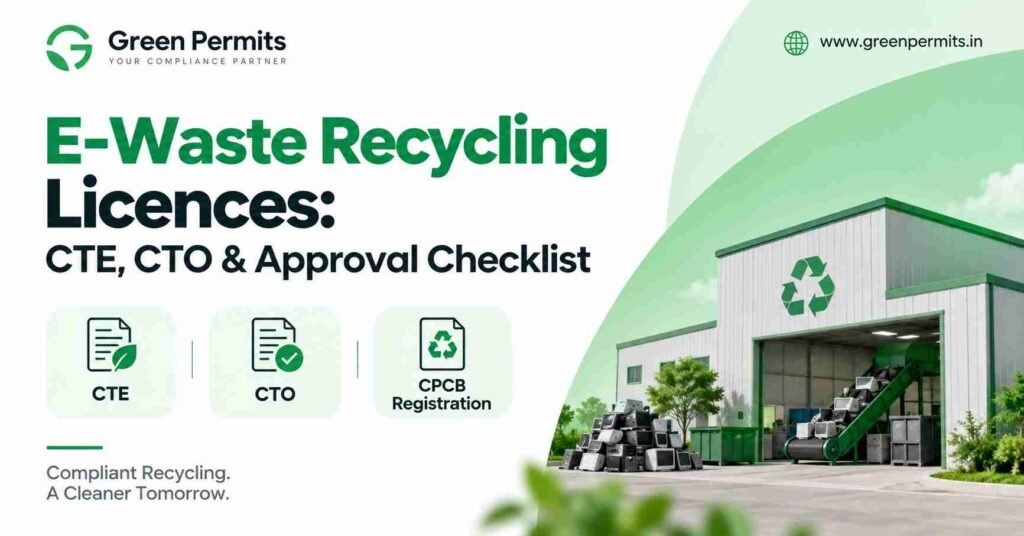
The most important approvals to plan are Consent to Establish (CTE), Consent to Operate (CTO), applicable Hazardous Waste Authorization and CPCB E-Waste Recycler Registration. Other permissions such as factory, fire, building and local industrial approvals may also apply depending on the state and facility.
The CPCB recycler-registration process does not work independently of state-level environmental approvals. CPCB’s October 2024 SOP specifically asks recyclers to provide copies of CTE, CTO and authorization, along with facility and technical information.
A practical licence map is:
| Approval | Authority | Stage |
|---|---|---|
| Consent to Establish | Concerned SPCB/PCC | Before establishment/installation as applicable |
| Consent to Operate | Concerned SPCB/PCC | Once the facility is ready and before compliant operation |
| Hazardous Waste Authorization | Concerned SPCB/PCC | Where applicable to the wastes handled/generated |
| E-Waste Recycler Registration | CPCB E-Waste Portal | After required facility approvals and evidence are available |
| Factory/industrial approvals | State authority | Depending on applicability |
| Fire/building permissions | Relevant state/local authority | Depending on building, storage and fire requirements |
The biggest mistake is treating each approval as a separate paperwork exercise. The capacity, process, machinery, facility address and pollution-control arrangements should remain consistent across the complete approval file.
CTE is the first major pollution-control approval to address when establishing a recycling facility.
The application should accurately explain the proposed recycling activity rather than simply describe the unit as a “scrap business.” The project file may need to identify the e-waste being handled, proposed recycling process, production or processing capacity, machinery, pollution sources, storage arrangements and environmental-control systems.
This is also why land should be assessed before major civil or machinery investment. Industrial zoning, surrounding land use, drainage, power availability, waste storage requirements and applicable SPCB siting conditions can influence whether the proposed site is workable.
The CTE should correspond with the plant that the promoter actually intends to build. Changing the process substantially after approval can create problems when the business later approaches the Board for CTO.
CTO becomes especially important for e-waste recyclers because CPCB uses the state-approved capacity as part of recycler-registration scrutiny.
The CPCB digital checklist specifically asks for the recycler’s annual recycling capacity as per CTO.
Suppose the machinery supplier states that a line can process 3,000 MT annually, while the CTO permits 1,500 MT annually. The CPCB application should not simply claim the higher machinery figure. Capacity needs to be supported by the environmental approval and the actual process installed at the facility.
Before CTO filing, therefore, review whether the completed facility matches the approved project in terms of machinery, storage areas, process flow, pollution-control equipment and operating capacity.
E-waste recycling can produce fractions or residues requiring controlled handling and disposal. The exact hazardous wastes depend on the recycling technology and incoming material.
CPCB’s recycler SOP requires the applicant to provide the applicable authorization issued by the concerned SPCB/PCC under the Hazardous and Other Wastes (Management and Transboundary Movement) Rules, 2016 as part of the recycler-registration file.
The authorization should therefore reflect the actual process and waste streams at the plant rather than relying on a generic waste description.
Storage and disposal planning should also be built into the facility layout so hazardous residues are not mixed with recovered commercial materials.
Under Rule 9 of the E-Waste (Management) Rules, 2022, recyclers are required to register on the portal and ensure that their facility and recycling processes follow CPCB standards or guidelines. Recyclers must also manage unrecycled fractions and residues appropriately and maintain records for verification or audit.
CPCB’s recycler application goes considerably beyond basic company KYC.
The digital checklist covers facility details, CTE and CTO, authorization, geo-coordinates, PAN and GST, e-waste categories, annual capacity, end products, material balance, recycling process flow and installed equipment. It also requires facility evidence and a self-declaration addressing authenticity of data and occupational health and fire safety.
The registration is valid for five years from the date of issue under the current CPCB recycler SOP.
Before submitting the CPCB application, an e-waste recycler should be able to answer “yes” to these core questions:
If one of these elements is missing, it is better to correct the compliance file before relying on the CPCB application.
For a new facility, compliance planning should start before plant installation.
First confirm the site, recycling activity and proposed capacity. Prepare the technical project information, process flow, plant layout and pollution-control strategy. The concerned SPCB/PCC CTE should then be addressed before establishing the facility as required.
Once the approved plant and pollution-control infrastructure have been installed, the business proceeds with operational consent and applicable waste authorization according to the relevant State Board procedure.
After CTE, CTO, authorization and plant-level evidence are available, the recycler can prepare the CPCB registration file.
This sequencing matters because CPCB is not simply registering a company. It is evaluating an actual recycling facility and its approved processing capacity.
Registration is not the end of compliance.
Under Rule 9, recyclers must maintain records of e-waste collected, dismantled, recycled and transferred, and must make those records available for verification or audit. They are also required to file quarterly and annual returns on the portal within the prescribed framework.
CPCB’s SOP also provides for verification of the recycling facility after registration. The facility should therefore continue operating in line with the machinery, capacity, process and environmental arrangements represented in its application.
Accurate records become particularly important where recovered materials and EPR certificates are involved.
The CPCB fee should not be confused with SPCB consent fees.
Under the supplied CPCB fee structure, first-time recycler registration is ₹15,000, amendment/addendum charges are ₹3,000, and annual maintenance charges are ₹5,000. Renewal after five years is ₹7,500 plus the prescribed transaction-linked component.
CTE, CTO, hazardous-waste authorization and other state-level government fees should be checked separately because they vary according to the applicable State Board framework, category and project details.
An e-waste plant works better when the technical project and environmental approvals are developed together rather than after machinery has already been purchased.
Green Permits can support businesses with feasibility and DPR preparation, plant-capacity planning, process flow, CTE, CTO, hazardous-waste authorization, CPCB recycler registration, document-gap review and compliance planning.
The objective is to keep the DPR, site, machinery, process, capacity and regulatory documents aligned throughout the project.
📞 +91 78350 06182
📧 wecare@greenpermits.in
👉 Book a Consultation with Green Permits